Shira Sebban

Shira Sebban

Monday, 22 July 2013

Wonderwomen has just published my piece on refugees

We Are All Boat People

Shira shares her view on the fate of asylum seekers in Australia
Shira SebbanShira Sebban
Australians are a caring lot. We’re so worried about asylum-seekers risking their lives on leaky boats that we want to dissuade them from taking the dangerous voyage in the first place.
If they make it to Australian waters, the Opposition wants to turn the boats around “when safe”, while the Government’s current ideal is to send the “queue jumpers” to Papua New Guinea (PNG): “If you come here by boat without a visa, you won’t be settled in Australia”.
But why not improve the efficacy of “legal” channels used by “genuine refugees” to reach Australia “legitimately”? We could start by speeding up the processing of the millions of refugees languishing in camps. To quote the Coalition: surely we want “to give Australians the confidence that only those invited … to our country will enjoy the safe haven of our nation”?
What about those who can’t seem to wait for an invitation and simply show up? Don’t tell anyone, but there isn’t an orderly line of refugees waiting patiently outside an Australian embassy.
The refugee world is chaotic. Usually it’s only those urgently needing to flee immediate danger, who would be desperate enough to ignore any deterrent to make that dangerous journey or to send their children to freedom. I should know: my family history is full of boat people, as I’m sure, is yours.
My father’s father was fortunate to settle in Toronto, Canada, after escaping the Ukrainian pogroms, arriving in 1913 as a teenager with his widowed sister and her children. No one “invited” them. His future wife had previously docked in Halifax, Nova Scotia, after fleeing Lodz, Poland. They grasped at the opportunity to make a better life – still the aim of most boat people today.
Saba's first Australian passport issued 20:6:46
My grandfather’s first Australian passport, issued on 20 June, 1946
In 1925, my mother’s parents had the foresight to leave Poland for Palestine, avoiding the fate of much of the family, decimated by the Nazis. When my grandfather couldn’t find work, he went down to the Tel Aviv harbour where he found two ships destined for South America and Australia respectively. Fortunately, he ended up in Melbourne in 1938, finding work as a laundryman. Today, he’d be called an economic migrant, who left his home in search of a better life elsewhere. Isn’t that how your family progressed too?
The society my grandfather encountered was closed. The White Australia Policy was in full swing, and in 1938, Australia’s Trade and Customs Minister, Thomas White, spoke against large-scale Jewish immigration at the Evian Conference: “as we have no real racial problem, we are not desirous of importing one”.
After World War II, however, my grandfather took advantage of the start of the immigration waves to bring out the other members of his family by boat.
Others were not so fortunate. Who remembers the M.S. St. Louis? I recently retraced the infamous ‘Voyage of the Damned’ at New York’s Museum of Jewish Heritage. The story of the ship dispatched by the Nazis on 13 May 1939, carrying close to a thousand German Jewish refugees, only to be rejected by Cuba and then the US and Canada, remains seared in my memory.
After 40 days hovering off the coast of “the free world”, all avenues were exhausted, and the “ship of shame” returned to Europe. Hitler had apparently been right: people seemed indifferent to the fate of those “filthy parasites”, despite the thousands of dollars they had paid satisfying visa requirements. While several European countries were persuaded to provide the refugees with temporary shelter, close to a third would eventually perish in the Holocaust.
A memorial Wheel of Conscience, erected in Halifax in 2011, blames their rejection on hatred, racism, xenophobia and anti-Semitism. The passengers had been expected to “wait their turn” as the US, increasingly resentful of refugees, who were seen as competing for jobs, didn’t even fill its restricted quotas – a fact only officially acknowledged 60 years later.
Sure, Nazism on the whole is dead and those asylum seekers we reject today won’t share the same fate. But most of those who reach Australian waters are eventually found to be genuine refugees.
Article 14 of the Universal Declaration of Human Rights states: “Everyone has the right to seek and to enjoy in other countries asylum from persecution”. To deter those who, according to the 1951 UN Convention and its 1967 Protocol relating to the Status of Refugees, have the right to seek protection from us and all other 147 signatories, is to ignore our democratic obligations. We would be returning people to the real risk of persecution, or transferring our responsibilities to a third, usually poor country. Sadly, refugees have come to be seen as a “burden” rather than as contributors.
Naomi as a little girl with parents
My maternal grandparents with my mother as a little girl
We don’t choose our families or where we’re born. A quirk of fate can mean the difference between freedom and subjugation. All we can do is make the best of the cards we’re dealt. Human effort is key to survival and improvement.
This year, a Ukrainian family joined our Passover celebration. It was their first experience of the festival of freedom. “The Soviet Government tried to make us like everyone else,” the father said. “They destroyed our synagogues. We didn’t have any Jewish books.” He was born near Kiev, the same city as my grandfather, who had escaped to Canada about a century ago. Had he not done so, my life experience could have been very different.
My children recently attended a chess competition in Sydney’s west, along with more than a hundred others of diverse cultures – a microcosm of modern Australian society. So many of the best Australian elements were evident – friendly rivals united by common interests, learning new skills and aspiring to improve – that it’s impossible not to feel proud.
Surely whether born here or only recently arrived, we all share goals to make our way in this still relatively “lucky country”, which has given our families such a precious opportunity. Let’s not deny that opportunity to others.
I’m not saying we should shoulder all the world’s refugees alone. Nor should those people smugglers, who take unscrupulous advantage of the vulnerable, escape prosecution.
What I’m asking for is a little kindness for those less fortunate than ourselves. After all, there but for a quirk of fate go I … and you … and indeed, the majority of Australians. And if you were that desperate, wouldn’t you want someone to extend a hand to you, as was extended to your family?


Tuesday, 9 July 2013

Wonder Women has published my piece on longing for community

Addicted to Community


Shira explores her longing for community.
Shira Sebban
Shira Sebban

I can no longer live a meaningful life without my community. My teenage son calls it an addiction. But my love for my community does not stem from mere habit, nor am I guided by compulsive need or blind infatuation. On the contrary, it has taken years of soul searching and trial and error to find the appropriate community where my family has been able to take root, grow and contribute.
Since time immemorial, philosophers like Aristotle and more recently, Spinoza have argued we are social animals. Indeed, most of us would be familiar with the ancient saying, ‘If I am not for myself, who will be for me? And if I am only for myself, what am I?’
Yet, it was not until my own father’s death ten years ago that my longing for community became so urgent. I had once asked him whether he would wish to be buried in the same cemetery as his parents and extended family in Toronto, Canada. ‘We should be buried within the community where we live,’ was my father’s reply. By that time, he had been residing in Melbourne for more than 30 years.
When my father died, I did not know where to turn. Not having been raised in a particularly religious home, I now felt unable to draw on faith for comfort.
This was not from want of trying – although we had belonged to various congregations in the past, my husband and I had not been able to find a spiritual home since moving to a new city some years earlier. As a result, we’d flitted from one congregation to the next, sampling a different one on each holiday but never feeling at home.
Nevertheless, I was touched when a religious leader, whom I had met in the course of my search, rang several times to see how I was faring. When upon the first anniversary of my father’s death, he offered me his premises for a memorial service, we finally made up our minds to join his congregation – after such generosity on his part, we believed it was the least we could do … even without faith.
That sense of welcome, warmth and support through both tough and good times remain major factors in why we renew our membership each year.
Indeed, as our sons have grown older, our family has come to attend services every week. This may be going against the trend – only 7.5 percent of Australians attend religious services regularly – but we believe that in this day and age when many of us do not even know whether we believe in God, it is still possible to contribute altruistically to and derive meaning from community based on religious civilisation.
Our congregation of choice integrates tradition with modernity, promoting all forms of equal rights, giving us the freedom to question and acknowledging our prerogative to consider different interpretations and viewpoints.
The school my children attend is another pillar of my community. Pluralistic and egalitarian too, it welcomes students of all backgrounds, who come together in mutual respect and are encouraged to work to make the world a better place. So committed have I become to this philosophy, that I decided to volunteer for the school board when my oldest son was in first grade and have remained actively involved ever since.
My oldest son has commented that without faith, a prayer service is just ‘a group of strangers singing together’. Yet, I have certainly discovered a sense of inner peace, spiritual uplift and intellectual stimulation through regular attendance at religious services and communal celebrations.
Alain de Botton in his 2012 book Religion for Atheists wrote that the relevance of such religions as Christianity, Judaism and Buddhism ‘to the problems of community are arguably never greater than when they … remind us that there is also value to be had in standing in a hall with a hundred acquaintances and singing a hymn together … or in sitting at a table with neighbours and partaking of lamb stew and conversation, the kinds of rituals which, as much as the deliberations inside parliaments and law courts, are what help to hold our fractious and fragile societies together’
De Botton – who was born Jewish but describes himself as a committed atheist – argues for the removal of religion’s ‘supernatural structure’ before it can help solve ‘many of the problems of the modern soul’.
My soul, however, does not need to be quarantined from the full gamut of my religion in order to thrive. Indeed, I am quite happy to keep on exploring the laws and customs of my heritage and culture, practicing rituals and contemplating ideas from within a religious framework. All I need is my community.
Shira Sebban – Life Issues
Shira is a Sydney-based writer and editor, who is passionate about exploring the challenges life throws at us through her writing. A former journalist with the Australian Jewish News, Shira previously taught French at the University of Queensland and worked in publishing. The mother of three sons, she also serves as vice-president on the board of her children’s school. You can read more of her work at http://shirasebban.blogspot.com.au/
Life Balance = Abandoned. The. Search.

Leave a Reply

Your email address will not be published. Required fields are marked*


Monday, 24 June 2013

Two articles in one day! On educating our children and ourselves


ON LINE OPINION - Australia's e-journal of social and political debateFor the joy of it

By Shira Sebban - posted Monday, 24 June 2013


Whatever happened to learning for the sheer joy of it? To embark on a quest out of curiosity and to savour the journey, motivated by a deep love of learning?

As Christopher B Nelson, president of St John's College in Annapolis, Maryland, has said: "The reward of learning simply for the sake of learning itself is a kind of fulfilment we call happiness. And this happiness is something we should want for all … students" (www.acenet.edu).

Yet, today, knowledge is becoming more "commodified". You can get a degree in almost anything, from professional nannying and auctioneering to clowning, paranormal studies and UFOs, and every institution seems to be at pains to tell you how useful your studies will be in helping you advance along a rewarding career path.

Not that there's anything wrong with that, as Seinfeld would say. Obviously, we all need to earn a living, and it certainly helps if you can do so in a meaningful and enjoyable way, especially after paying considerable sums of money preparing for the privilege. Indeed, job fulfilment is ostensibly more important to Gen Y (aka Millenniums or Millennials) than it has been to any previous generation. Nevertheless, learning for learning's sake seems to have little to do with the whole process.

I recently attended a Year 10 subject selection night at the University of New South Wales (UNSW) with my teenage son, where we discovered more than 300 degrees on offer – students can nominate up to nine they would like to study – each accompanied by a list of associated career opportunities.

Amongst the myriad of documentation we collected was a Parent Information Guide, which told us in bold yellow print: "It's time for your child to leave high school behind and take their first steps towards a rewarding career". Studying at UNSW, it maintained, could "give them the best launchpad into the rest of their lives".

No mention of love of learning here. The closest we got was a paragraph in the parent guide, encouraging us to ask our children what subjects they "enjoy" as a way of helping them to discover "degrees that match their abilities". Meanwhile, we were bombarded with statistics about how UNSW graduates "are in high demand from employers" and "are in the top 5% for median starting salaries".

While career paths for the more practical degrees, such as actuarial studies or optometry, are quite evident, others are far more vague. Those interested in an Arts degree, for example, of which I myself am a proud holder, are told: "Students in the humanities and social sciences learn a wide range of skills that open up many career opportunities. No other course of study provides you with the same combination of broad intellectual growth, skills development in research and analysis, the ability to communicate effectively and the capacity to think critically about the global environment we live in."

Certainly all most valuable skills to acquire. Although not pointing to specific jobs, the desire to appear useful and therefore attractive to potential Arts students is obvious. And with good reason. In 2012, only about 76 per cent of new bachelor degree graduates from Australian institutions had found full-time employment within four months of completing their tertiary studies (www.graduatecareers.com.au). In other words, one-in-four students had not, and guess who they were most likely to be?

Nothing much seems to have changed in that regard since I graduated more than 20 years ago: Arts, and for that matter, Science graduates are often compelled to search long and hard for meaningful entry into the Australian work place, with many employers favouring more obvious and practical skills, such as those offered by a medical, accounting or engineering degree. There is even a Know Your Worth chart measured by how many burgers a young graduate can buy with their starting salary! Newly fledged dentists are in first place with more than 21,000 burgers, leaving those humanities graduates fortunate enough to find employment languishing in their wake on a paltry 12,000.

I can still recall the days when as a newly married, 20-something graduate, I moved from Melbourne to Brisbane. Armed with a French Honours degree with a major in philosophy, I was keen to find work, only to be met by the blank stares of my prospective Queensland employers. How I wished I lived in the more open-minded United Kingdom, where philosophy graduates were sought after banking employees! As it was, unless I wanted to be a teacher or agreed to leave my husband and move to Canberra to take up a job in the public service, there seemed little hope for me.

Today, philosophy at my alma mater, the University of Melbourne, is a shadow of what it used to be and has merged with history. Indeed, many subjects, particularly from the liberal arts, are disappearing precisely because they are no longer attracting students in large numbers, at least not the all-important, full-fee-paying international ones, and so are no longer seen as financially viable. Gender Studies, for example, is gradually being eliminated from many Australian universities, as are various history courses, religion, linguistics and foreign languages, the number of which being taught has more than halved over the past decade.

As renowned philosopher Raymond Gaita has said so eloquently, "Some essential disciplines of the humanities and the sciences – philosophy and (even) physics, for example – have become mendicants for a respected place in institutions that should honour them, but honour instead the study of hospitality and gaming" ("To Civilise the City?" Meanjin, May 2012).

Since ancient times, the liberal arts – traditionally encompassing grammar, rhetoric and logic, mathematics, geometry, astronomy and music – were seen as the very bastion of learning for learning's sake, providing a good grounding for life. The epitome of such a well-rounded education were "polymaths" or "Renaissance men or women" – those deeply knowledgeable, highly skilled and multi-talented, yet still modest, individuals, as personified by Leonardo da Vinci. As the accomplished Italian Leone Battista Alberti (1404-72) said, "a man can do all things if he will". He was speaking with a certain authority, having been a priest, author, architect, artist, linguist, poet, philosopher, scientist, mathematician, inventor, horseman and archer!

While certainly not in the same league, my grandfather was a kind of Renaissance man. Although he never had a formal secular education, and much to my envy, never even sat an exam, he was blessed with an inquiring and incisive mind, an insatiable desire for knowledge and a photographic memory. A laundryman by trade, he worked hard to become established before devoting the rest of his life to reading, thinking, discussing, writing, appreciating music and art, and travelling.

The patriarch of our family, my grandfather would preside over gatherings, regaling the table with such passions as the problems of justice and of individual freedom within the rule of law. Alternatively, he might have been keen to discuss what he had read that particular day which, given his eclectic interests, could range from a biography of the Italian Renaissance "father of science" Galileo Galilei or the writings of the 20th century philosopher and mathematician Bertrand Russell to biblical commentaries on Abraham, Moses or Samuel, various newspaper articles, which he would mark for others to read – our house was piled high with them – or even an account of the Shakers, a utopian Christian sect, some of whose former American settlements he visited and whose virtual demise fascinated him. Even while on an otherwise disappointing holiday in Tahiti, he derived enjoyment from reading daily doses from a volume of Albert Einstein's essays, which he had happened to pick up at Sydney airport!]

Careers were not as important to my grandfather as the sheer love of learning, although he certainly emphasised the need to work to secure financial independence and be responsible for oneself. Indeed, whenever his children or grandchildren would ask his advice on our future studies, he would steer us in the direction of a great body of thought such as science or philosophy and encourage us to be creative and aim for excellence in all our endeavours. He himself set an example by striving to learn university-level mathematics in his fifties.

When I was choosing my university subjects, I enrolled in a philosophy major as a matter of course. It was just what our family did. Without my grandfather's influence, I may never have even been exposed to Socrates and Plato or wrestled with the ideas of 18th century Scottish moral philosopher David Hume. That is not to say that they were always well taught. But at least I had the opportunity to encounter them.

Today it is certainly harder, albeit impossible, to be a Renaissance man or woman. Bombarded with data from all directions, many of us are suffering from "information overload". Socrates was ostensibly humble enough to admit more than 2000 years ago that he "knew nothing, except just the fact of his ignorance" (Diogenes Laertius, Lives and Opinions of Eminent Philosophers 5: 32). How much more true is that today!

As knowledge increases, we tend to sub-specialise even more, with new experts springing up in a range of fields that were unknown just a few years ago, from windfarm or fuel cell engineers, app designers and social media managers to Zumba teachers and carbon credit traders. And yet Gen Y will be expected to retrain for up to five different careers in a lifetime.

One of the aims of the school my children attend is for them to develop the skills to become "life long learners". I hope they come to appreciate the value of a good education, one that encourages them always to keep their mind open, reading widely, constantly being exposed to new ideas and experiences and discovering joy through learning. Obviously to do so successfully, they will need that most precious commodity, time. Hopefully, however, they won't need to wait until retirement before getting to explore what they've always dreamed of doing. I'm encouraging them to discover and pursue their passions now and to keep on chasing them for the rest of their lives.

My take on community in eurekastreet.com.au


Addicted to community

Shira Sebban |  25 June 2013
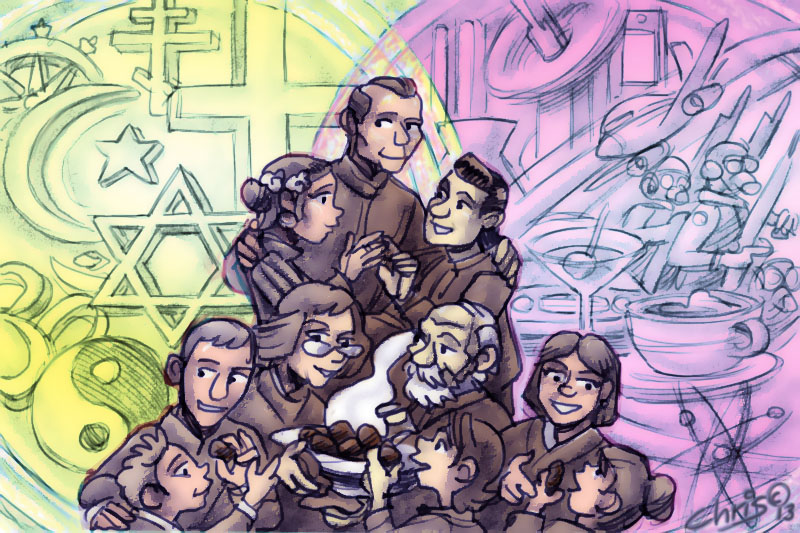
'Community' by Chris Johnston. In the background we've got the religious and the material world meshing together, behind a group symbolizing community. At the top of the group, we've got some sort of celebrant joining together a couple, and below them a diverse group sharing a meal.I can no longer live a meaningful life without my community. My teenage son calls it an addiction. But my love for my community does not stem from mere habit, nor am I guided by compulsive need or blind infatuation. On the contrary, it has taken years of soul searching and trial and error to find the appropriate community where my family has been able to take root, grow and contribute.
Since time immemorial, philosophers like Aristotle and more recently, Spinoza have argued we are social animals. Indeed, most of us would be familiar with the ancient saying, 'If I am not for myself, who will be for me? And if I am only for myself, what am I?'
Yet, it was not until my own father's death ten years ago that my longing for community became so urgent. I had once asked him whether he would wish to be buried in the same cemetery as his parents and extended family in Toronto, Canada. 'We should be buried within the community where we live,' was my father's reply. By that time, he had been residing in Melbourne for more than 30 years.
When my father died, I did not know where to turn. Not having been raised in a particularly religious home, I felt unable to draw on faith for comfort.
This was not from want of trying — although we had belonged to various congregations in the past, my husband and I had not been able to find a spiritual home since moving to a new city some years earlier. As a result, we'd flitted from one congregation to the next, sampling a different one on each holiday but never feeling at home.
Nevertheless, I was touched when a religious leader, whom I had met in the course of my search, rang several times to see how I was faring. When upon the first anniversary of my father's death, he offered me his premises for a memorial service, we finally made up our minds to join his congregation — after such generosity on his part, we believed it was the least we could do ... even without faith.
That sense of welcome, warmth and support through both tough and good times remain major factors in why we renew our membership each year.
Indeed, as our sons have grown older, our family has come to attend services every week. This may be going against the trend — only 7.5 per cent of Australians attend religious services regularly — but we believe that in this day and age when many of us do not even know whether we believe in God, it is still possible to contribute altruistically to and derive meaning from community based on religious civilisation.
Our congregation of choice integrates tradition with modernity, promoting all forms of equal rights, giving us the freedom to question, and acknowledging our prerogative to consider different interpretations and viewpoints.
The school my children attend is another pillar of my community. Pluralistic and egalitarian too, it welcomes students of all backgrounds, who come together in mutual respect and are encouraged to work to make the world a better place. So committed have I become to this philosophy that I decided to volunteer for the school board when my oldest son was in first grade and have remained actively involved ever since.
My oldest son has commented that without faith, a prayer service is just 'a group of strangers singing together'. Yet I have discovered a sense of inner peace, spiritual uplift and intellectual stimulation through regular attendance at religious services and communal celebrations.
Alain de Botton in his 2012 book Religion for Atheists wrote that the relevance of such religions as Christianity, Judaism and Buddhism 'to the problems of community are arguably never greater than when they ... remind us that there is also value to be had in standing in a hall with a hundred acquaintances and singing a hymn together ... or in sitting at a table with neighbours and partaking of lamb stew and conversation, the kinds of rituals which, as much as the deliberations inside parliaments and law courts, are what help to hold our fractious and fragile societies together'.
De Botton — who was born Jewish but is now a committed atheist — argues for the removal of religion's 'supernatural structure' before it can help solve 'many of the problems of the modern soul'.
My soul does not need to be quarantined from the full gamut of my religion in order to thrive. Indeed, I am quite happy to keep on exploring the laws and customs of my heritage and culture, practicing rituals and contemplating ideas from within a religious framework. All I need is my community.

Thursday, 6 June 2013

My article on Caring for My Mother and Dealing with Alzheimer's has just been published by Wonderwomen.


Caring for My Mother: Burden or Responsibility?

Shira walks the ‘daughter track’ and finds rewards.
Shira SebbanShira Sebban
I am my mother’s advocate. Together with my sister, I manage her household, supervise her carers, pay her bills, run her errands. Most importantly, we champion her rights, providing her with a voice at a time when tragically, she can no longer stand up for herself due to the decade-long ravages of Alzheimer’s disease.
My mother used to be my role model and my best friend. Passionate, strong, courageous and intelligent, she was a brilliant scholar and a loving parent and grandparent, the person I could turn to for advice and companionship at any time.
Now the tables have been completely turned. The child who started out entirely dependent on her mother has matured to become the one on whom her mother depends.
Since my mother has been afflicted by illness, I constantly feel her absence like a gaping hole in my life. She may still look like my mother and remain physically near, but mentally and spiritually, she is no longer there for me.
When someone has Alzheimer’s, there is plenty of time to say goodbye. Deterioration occurs slowly, with changes almost imperceptible at first and then becoming only gradually more noticeable. Alzheimer’s is a cruel illness as my late maternal grandfather noted, telling my mother when sadly, he was in the throes of the disease himself, “I am losing my I”, by which he meant that he was losing what made him whom he was as a person.
Moreover, gradually much of the world forgets its sufferers. Many friends stop writing or visiting; it is almost as if people are too embarrassed and don’t know how to deal with someone who can no longer respond except with a smile, a look or a touch.
Long ago we promised our mother that we would never put her in a nursing home. And we have honoured that promise, convincing her early on to move to the same city where we live and striving to ensure that she continues to reside with dignity in her own home. As card-carrying members of the ‘sandwich generation’, we have chosen to juggle her needs along with those of our own young families.
While that may not be the right decision for everyone, it has certainly proven to be the correct option for us, and we are fortunate to have had the freedom to be able to make that choice. While our mother can no longer thank us, I know that she is grateful. Before she lost the ability to speak, she was expressing her gratitude to everybody who helped her, and I’m sure she would still be doing so today if she could.
Broadcaster Sandra Tsing Loh has said on National Public Radio’s Talk of the Nation that the “daughter track is far more open-ended [than the mommy track] and has no rewards at the end except for death” (29 February, 2012).
No rewards?
Even though I’d give anything to have my mother back again as she once was, I know that caring for her has taught me to be kinder and more patient. It has also given me an opportunity to set a good example for my children, teaching them to be decent human beings. As my 11-year-old son said, “We owe it to our parents to look after them in their old age. They care for us when we’re young and then it becomes our turn to care for them.”
Moreover, I feel rewarded that I’m providing my mother with a good quality of life from which she still derives some enjoyment.
Yes, despite everything, she still gets some joy out of life. Contrary to popular misconception, advanced Alzheimer’s sufferers are not vegetables. Although the illness may cocoon them from feeling the full brunt of life’s emotions, they still experience pain and pleasure, peace and agitation. My mother continues to appreciate good food, especially dark chocolate, music, flowers, massage and the warmth of the sun. She may be confined to a wheelchair, but she is not confined to her apartment, attending an adult day care program twice a week, going on outings and visiting with her family.
She is still a human being – even if she has lost her “I”.
Shira Sebban – Life Issues
Shira is a Sydney-based writer and editor, who is passionate about exploring the challenges life throws at us through her writing. A former journalist with the Australian Jewish News, Shira previously taught French at the University of Queensland and worked in publishing. The mother of three sons, she also serves as vice-president on the board of her children’s school. You can read more of her work at http://shirasebban.blogspot.com.au/
Life Balance = Abandoned. The. Search.
© Feature photograph by Dominika Ferenz

Tuesday, 21 May 2013

My (hopefully) uplifting piece on death has just been published on Online Opinion


Making the most of life

Like most of us, I usually try to avoid thinking about death. Its seeming finality – the enormity of the thought that we are never coming back – is not something I have ever managed to face and comprehend fully no matter how hard I try. Instead, heart thumping, courage faltering, I usually come to a screeching halt just before plunging over what seems like the looming precipice beyond.
Yet, on the tenth anniversary of my beloved father's passing and after attending the funeral of my dear friend Shimon, I find myself drawn to musing about death and to be able to do so more calmly and rationally than ever before.
Selfless and discreet, Shimon was a caring man, a listener, who preferred not to speak about his own trials and tribulations and devoted much of his life to helping others through his nursing work and later as a hospital chaplain. Listening to the eulogy for Shimon, I felt uplifted and a sense of inner peace soothed my soul – just as my friend would have wanted.
At Shimon's funeral, we listened to the recitation of a beautiful poem, Life is a Journey, by the late Alvin Fine, which provides a realistic summary of the fallible human condition. Failure certainly does not preclude meaning:
From defeat to defeat to defeat, until, looking backward or ahead,
We see that victory lies not at some high place along the way,
But in having made the journey, stage by stage, a sacred pilgrimage."
Perhaps I have become more aware of death at a time when I have been writing the life stories of my late grandfather and of my mother, who is now sadly in the advanced stages of Alzheimer's disease. In the course of this journey, I have been fortunate to have been able to trawl through a treasure trove of family letters, some dating back as far as the 1930s – snippets of social history, which regrettably, with the advent of email and the Internet, come to an end around the year 2000. It is sobering to realise that I will not be leaving the same legacy for my children.
Written in a multitude of languages, these letters have criss-crossed the globe. Desperate letters from a sister in Lodz, Poland, in 1935 to her sister, my late grandmother, in Tel Aviv; hundreds of letters, which followed my mother's journey from Tel Aviv to Melbourne in the late 1940s and then on to London and Montreal a decade later and back to Melbourne once more in the late 60s; and letters spanning four decades from my Canadian father's family in Toronto to their brother in Melbourne and from my adopted Melbourne "aunt" and close family friend to my mother, providing vignettes of what life was like for Australians in the 1950s and 60s.
In perusing these letters, each preserved in its original envelope, what quickly becomes clear is that no matter what advances technology may bring, fundamentally little has changed: human beings still experience joy and suffering, success and failure, complain about the economy, celebrate births and marriages and bemoan divorces and deaths among family and friends. Life continues – whether you are there to witness and experience it or not.
As the ancients taught: "[T]here is nothing new under the sun." (Ecclesiastes 1.9) "One generation passes away, and another generation comes; And the earth abides for ever." (Ecclesiastes 1.4)
So much toil and trouble, fuss and bluster, anguish and elation. Yet, after we are gone and our contemporaries have also vanished with the passing years, what remains? For the creative few, a contribution to knowledge they may have made; book they may have written; artwork they may have produced. For those with means, a legacy in bricks and mortar or a charitable foundation to which they may have contributed. For the vast majority of us, the living legacy of our children, grandchildren, and possibly even great-grandchildren, as well as photos and other memorabilia and perhaps sayings or traditions handed down from generation to generation.
My late father was a quiet man. In his own discreet way, he did whatever he could to care for and support his family. He would do anything for the ones he loved and he was everything to us. To him, home and family came first, and I will never forget how on the day he died, he urged me to leave his hospital bedside and return to my husband and young children because "they need you".
My father stood like a pillar at the centre of our lives. We were all accustomed to depending on him, and when he died, we felt his absence keenly. In the days and months that followed, I could not help but ask myself how it would have bothered anyone if he had been allowed to continue driving through the streets, helping to lighten the load of his family and friends?
Until my father's passing, I had been fairly sure that there was nothing after death. After spending years studying philosophy, I could not seem to accept the idea of "eternal life" and "everlasting peace" in the "world to come".
Yet, when I lost my father just a few hours after spending the night tending to his needs in hospital, I began to question my former apparent certainties. How was it possible that my father could be there one minute and gone the next? What had happened to his persona, to the essence of who he had been, to his soul?
Ecclesiastes teaches: "And the dust returns to the earth as it was, but the spirit returns unto God, who gave it." (12.7) Today, while I am still not sure whether or not I believe in God, I draw comfort at least from striving to honor my father's memory through my actions.
As Sylvan Kamens and Jack Riemer wrote in their poem, We Remember Them, also recited at Shimon's funeral:
As long as we live, they too shall live,
for they are now a part of us,
as we remember them.

Thursday, 16 May 2013